

An academic question frequently raised for consideration is: Why do users, who are accustomed to the hyper-speed resolution of casino games, dedicate their attention to sporting events that require several hours of competition to conclude? The answer, rooted in Behavioral Economics, lies in the “Illusion of Control” and the pursuit of “Analytical Mastery.” While the vast majority of casino games rely entirely on predetermined mathematical probability and sheer luck, the outcome of a sporting event is contingent upon tangible, real-world variables. These include the physical conditioning of the athletes, meteorological conditions, the tactical acumen of the team managers, and complex psychological motivations.
For the user, the ability to apply their accumulated knowledge and passion for their favorite sports towards forecasting outcomes elevates their experience from being a “Passive Spectator” to becoming an “Active Participant.” The integration of the sports betting section into stake casino thereby constructs a Comprehensive Environment. This ecosystem simultaneously satisfies those seeking the short-term adrenaline spikes of the casino and those who prefer the long-term, data-driven analysis of sports. Understanding this dual-faceted dimension is the crucial starting point for evaluating the true value of an integrated digital platform in the 21st century.
What the Betting Interface Provides to the User

Within the academic discipline of Human-Computer Interaction (HCI), an Interface is not merely a superficial mask draped over a database; it functions as a “Cognitive Tool” that dictates the boundaries and formats of user perception. When a user navigates into the betting section, they are immediately confronted with a Big Data-level volume of information. This encompasses expansive lists of leagues, fluctuating decimal odds, deep historical statistics, and chronological event schedules. The primary engineering challenge for the platform is how to present this massive dataset without inducing a state of paralyzing Information Overload.
A meticulously designed betting department interface acts as a highly efficient Visual Filter. The architecture of the Betting Line is organized logically. Typically, it begins by categorizing mainstream sports within a Sidebar Navigation menu, while prominently displaying the most popular or immediately impending events in the center of the screen.
The strategic application of Color Contrast to denote the algorithmic movement of odds — for example, utilizing green when the price ascends and red when the price descends — empowers the user to perceive shifting Market Sentiment within milliseconds, completely bypassing the need to read and process every individual digit.
The frictionless convenience of Event Selection is another critical factor driving user satisfaction. The moment a user clicks on a desired market odd, that specific data point is smoothly transmitted to the “Bet Slip,” usually located on the right flank of the interface. This bet slip functions as an automated digital calculator. It instantaneously computes and displays the Potential Return the exact moment the user inputs their intended capital stake. The absolute clarity of this data presentation not only drastically mitigates the risk of User Error during order input but also bestows a profound “Sense of Control.” The user inherently recognizes that every financial decision they execute is processed on a foundation of transparent, verifiable data, which forms the bedrock of trust within any digital ecosystem.
What Makes Live Betting So Compelling
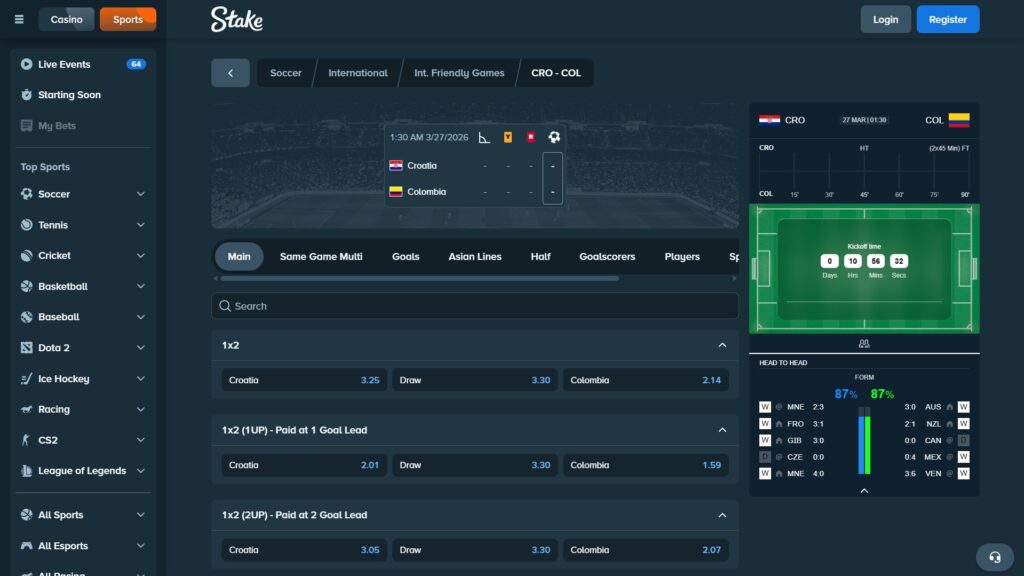
If Pre-match Betting is akin to a slow, methodical game of chess requiring extensive advanced planning, Live Betting (or In-play Betting) is the equivalent of high-frequency stock trading on a volatile Wall Street floor. The Live Betting paradigm has completely revolutionized the sports wagering industry and currently operates as the most potent magnetic force for user engagement in the modern era. Why has this specific feature achieved such overwhelming popularity?
Firstly, it introduces profound “Spatio-temporal Dynamics.” Live betting shatters the traditional constraints of time. Users are no longer forced to wait until the final whistle to ascertain the outcome of their analysis; they can interact with the event dynamically as it unfolds on their screens. When a critical incident occurs on the field of play — such as a player receiving a red card or a penalty being awarded—the odds are instantaneously Recalibrated by backend artificial intelligence algorithms in a matter of milliseconds. This intense window of volatility represents a prime window of opportunity for skilled analysts capable of accurately reading the “Momentum” of the match.
Secondly, it generates unparalleled “Emotional Engagement and Immersion.” Watching a sporting broadcast while simultaneously maintaining an open stake casino betting window exponentially amplifies the user’s feeling of Presence within that specific event. Every single pass and every foul committed suddenly acquires statistical and financial significance. For instance, in regions possessing a hyper-specific sporting fanaticism, such as the stake casino india market, live betting on Cricket matches is a major social phenomenon. Cricket possesses an Episodic Nature, which perfectly accommodates the continuous adjustment of strategies and ball-by-ball situational assessments. Possessing an interface that can respond to these micro-rhythms with absolute precision is what crafts an immersive experience, retaining users within the system for durations significantly longer than traditional betting formats.
Why the Diversity of Betting Options is Crucial
The most prevalent misconception among beginners studying betting economics is the belief that wagering markets are strictly limited to predicting which team will win, lose, or draw (the 1X2 Market). In reality, a fully mature sports forecasting ecosystem presents an incredible depth of Market Depth and Variety. This granularity is a factor of paramount importance to both the long-term sustainability of the platform and the strategic viability of the user.
Why is this diversity so critical? Viewed through the lens of Information Asymmetry theory, every individual user possesses a unique set of knowledge, specialized expertise, and specific interests. Certain analysts might lack the confidence to definitively predict the outright winner of a specific fixture. However, they may possess statistical models indicating that both competing teams suffer from exceptionally weak defensive structures. Consequently, the Over/Under Totals market becomes a vastly more appropriate and statistically sound option for their capital.

Furthermore, the provision of highly specific Scenario-based Options, such as forecasting the individual statistical output of a single athlete (Player Props), predicting the exact number of corner kicks, or the total yellow cards issued in a football match, empowers users to leverage their own “Niche Knowledge” to secure a mathematical edge. By refusing to confine users to a unidimensional betting format, and instead granting them the latitude to engineer their own statistical interaction scenarios, the platform demonstrates a profound respect for user intellect and grants true freedom in Risk Management. Ultimately, this massive diversity functions as a safety net, capturing a wide array of differing interests, preventing user stagnation, and cementing the platform’s image as a professional entity that truly comprehends the physiology of sports analysis.
Frequently Asked Questions (FAQ)
In the concluding segment of this comprehensive academic lecture, I have compiled and analyzed a series of Empirical FAQs that are frequently debated among academics, students, and individuals who are newly acquainting themselves with the interface architecture of sports betting. The responses provided will strictly adhere to the principles of academic neutrality and systematic explanation, ensuring that readers achieve clarity and can effectively apply these concepts to the analysis of digital behavior.